
India’s Steel Decade: Production, Consumption Rise Together as Economy Builds for the Future
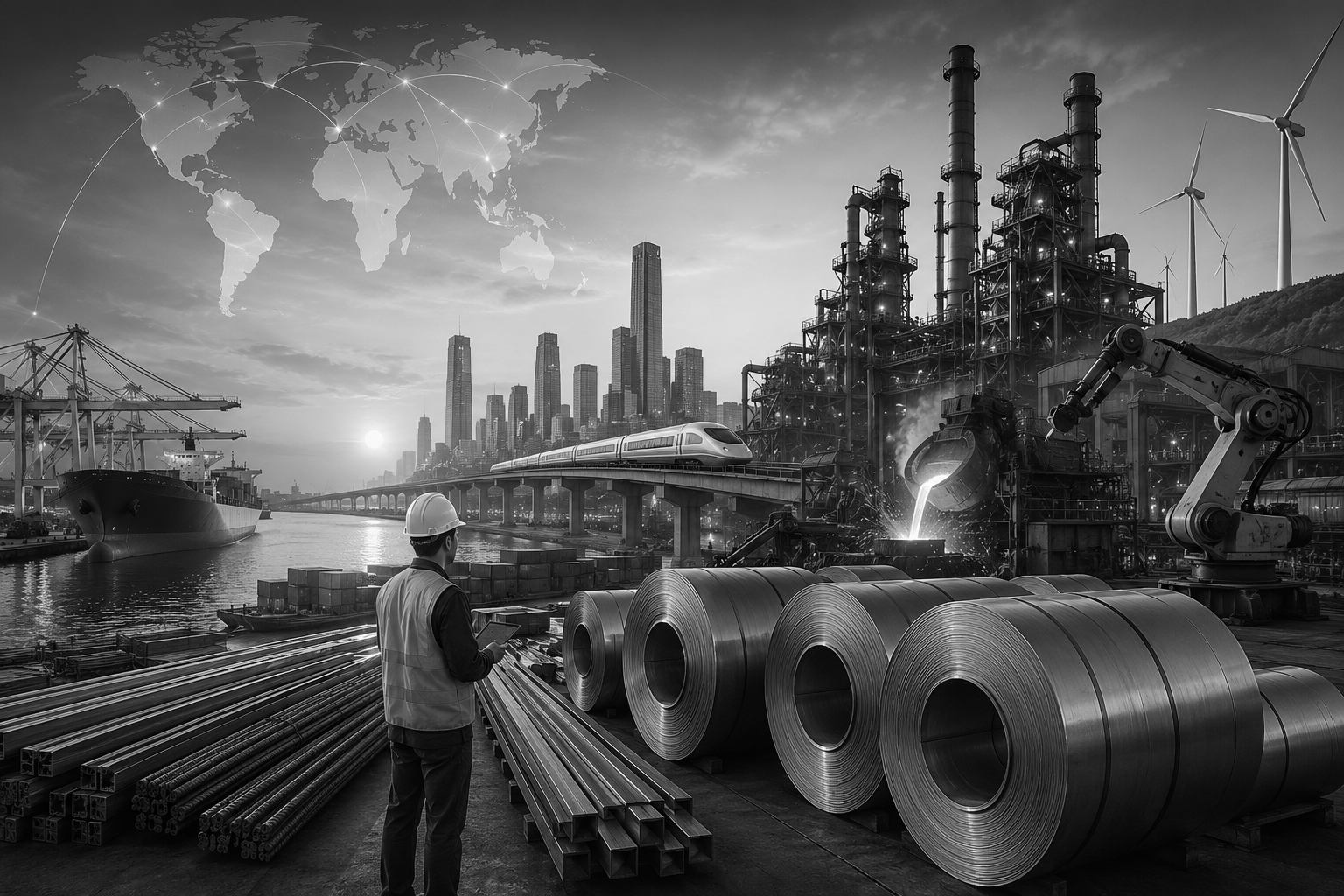
India’s steel story is entering a new phase. For decades, steel was seen as a basic industrial material, important but unglamorous. Today, it is one of the clearest markers of India’s economic momentum. Every new highway, metro line, railway bridge, airport terminal, industrial corridor, factory shed, apartment tower, automobile plant and renewable energy project carries within it a rising demand for steel.
The numbers tell the story. India is now producing and consuming roughly the same order of steel, at around 160 to 170 million tonnes a year. In FY 2025-26, India’s crude steel production touched 168.4 MT, while total steelmaking capacity stood at about 220 MTPA. The country is now moving towards the National Steel Policy target of 300 MTPA capacity by 2030-31, a milestone that would mark a major expansion of India’s industrial base.
That makes steel not just an industrial sector, but a national growth engine. At an average price of about ₹60 per kg, India’s annual steel consumption of around 160 million tonnes translates into a broad market size close to ₹10 lakh crore. This is the metal economy behind India’s construction boom, highways, engineering goods, railways, automobiles, power transmission, ports, defence manufacturing and urban expansion.
A Steel Giant, But Still Far Behind China
India has reason to be proud. It became the world’s second-largest crude steel producer in 2018 and has retained that position since. In 2025, India produced about 165 million tonnes of crude steel. That is far ahead of the United States, which produced roughly 82 million tonnes, and ahead of the European Union’s core steel output.
But the comparison also shows the scale of China’s dominance. China produced close to 960 million tonnes in 2025, nearly six times India’s output. So India is a global steel power, but not yet a steel superpower in the Chinese sense.
The more important point is the direction of travel. While many mature economies are seeing slow or stagnant steel demand, India’s steel consumption is still rising because the country is still building its physical economy. Steel consumption has more than doubled over the past decade, driven by public infrastructure spending, real estate, automobiles, capital goods, energy infrastructure and manufacturing. For a developing economy, rising steel consumption is often a sign that roads, railways, factories, warehouses and cities are being built at scale.
Production Broadly Meets Consumption
India’s steel production now broadly meets domestic consumption. The country does import and export steel, but in relation to total demand, these flows are not the central story. Exports are only around a few million tonnes a year, while total domestic consumption is well above 160 million tonnes. Imports and exports matter for prices, product availability and trade policy, but they do not change the larger picture that India is mostly producing the steel it consumes.
There is, however, an important qualification. India still imports certain categories of specialty steel, including high-grade automotive steel, electrical steel, alloy steel and strategic-use steel. These are not always large in volume, but they are high in value and technologically important.
This is why the government’s Production Linked Incentive scheme for specialty steel matters. The idea is not merely to produce more steel, but to produce better steel. India wants to reduce dependence on imported high-grade steel used in automobiles, electrical equipment, defence, renewable energy, precision engineering and capital goods. The Ministry of Steel has said the PLI push is already helping India move towards self-reliance in specialty steel.
The Big Steel Groups Behind The Expansion
India’s steel landscape is now a mix of large public sector producers and aggressive private companies. The major names include SAIL, Tata Steel, JSW Steel, Jindal Steel, ArcelorMittal Nippon Steel India, RINL Vizag Steel, NMDC Steel, and several secondary and regional producers.
SAIL remains central to India’s public sector steel legacy, with plants such as Bhilai, Bokaro, Rourkela, Durgapur and IISCO. Tata Steel brings one of India’s oldest industrial traditions, anchored by Jamshedpur and expanded through Kalinganagar and other facilities. JSW Steel has emerged as one of the country’s most aggressive private sector steelmakers, with major facilities such as Vijayanagar and Dolvi.
Jindal Steel is a separate group from JSW, though both trace their roots to the larger O.P. Jindal family business legacy. AM/NS India, backed by ArcelorMittal and Nippon Steel, is also expanding significantly.
The sector is also a major employer. Steel supports lakhs of direct jobs and many more indirect livelihoods across mining, logistics, ports, railways, engineering, construction, fabrication, trade and downstream manufacturing. In practical terms, every million tonnes of steel capacity creates an ecosystem far beyond the factory gate.
Why India Cannot Simply Repeat China’s Steel Miracle
It is tempting to ask why India cannot scale steel the way China did. The answer is that China’s steel boom was a once-in-a-generation industrial event. It combined mass urbanisation, export-led manufacturing, huge state-backed infrastructure spending, massive real estate construction, cheap credit, globalisation and China’s entry into the WTO. No other country is likely to repeat that exact combination.
India’s growth path is different. Its urbanisation is slower, its real estate market is less steel-intensive than China’s high-rise construction boom, and its infrastructure spending, while large, is not at the extraordinary scale China sustained for years. India also has to grow in a world that is more protectionist, more climate-conscious and more wary of industrial overcapacity.
That may actually be a strength. India does not need to burn the bank chasing steel capacity for its own sake. A steadier path, where capacity expands in line with real demand, is healthier. Steel plants are capital-intensive, take years to build, require land, power, water, rail and port connectivity, and depend heavily on raw materials. Overbuilding capacity without demand can weaken companies, banks and public finances.
The Bottlenecks: Coking Coal, Capital And Clearances
India has significant iron ore reserves, but the more difficult raw material problem is coking coal. Integrated steelmaking still depends heavily on metallurgical coal, and India imports most of its requirement. This makes steel growth not only an industrial issue, but also an energy security and foreign exchange issue.
Capital is another constraint. A modern integrated steel plant can cost billions of dollars. Expansion also depends on mining leases, environmental clearances, logistics, port capacity, water availability, power supply and stable policy. Steel is not like software, where scale can increase almost instantly. It is a slow, heavy, long-cycle industry.
This is why the 300 MTPA target must be understood properly. It is not a casual target. It requires sustained demand, patient capital, raw material security, faster project execution, better logistics and a more competitive downstream manufacturing base.
The Green Steel Challenge
The next phase of India’s steel journey will not be only about quantity. It will also be about emissions. Steelmaking is one of the world’s most carbon-intensive industrial activities, and India’s challenge is to expand production while gradually reducing carbon intensity.
India has committed to net zero emissions by 2070. The steel sector will have to be part of that transition, though nobody can yet claim that the full pathway is clear. Green hydrogen, scrap-based electric arc furnaces, renewable power, energy efficiency, carbon capture and better recycling will all be part of the answer.
The government has already moved towards green steel initiatives and cleaner production frameworks. But the technology, economics and timelines remain difficult. For now, the honest position is this: India intends to move towards green steel, but the journey will be gradual. The country cannot stop building. It must build cleaner.
India’s Steel Decade
India’s steel sector is in a sweet spot. Production is rising. Consumption is rising. Domestic capacity broadly meets demand. Imports remain manageable and are increasingly focused on higher-value categories that India is now trying to make at home. Exports give India a place in global markets, but the real strength of the sector is domestic demand.
The 300 MTPA capacity target by 2030-31 is ambitious, but no longer unrealistic. If India gets there without reckless overcapacity, while improving quality, reducing import dependence in specialty steel and preparing for greener production, it will mark a major industrial achievement.
Steel may not always attract the glamour of semiconductors, artificial intelligence or electric vehicles. But without steel, none of those futures can be built at scale. India’s steel industry is already a ₹10 lakh crore pillar of the economy. If managed well, it can become one of the strongest foundations of India’s journey towards becoming a developed economy.